

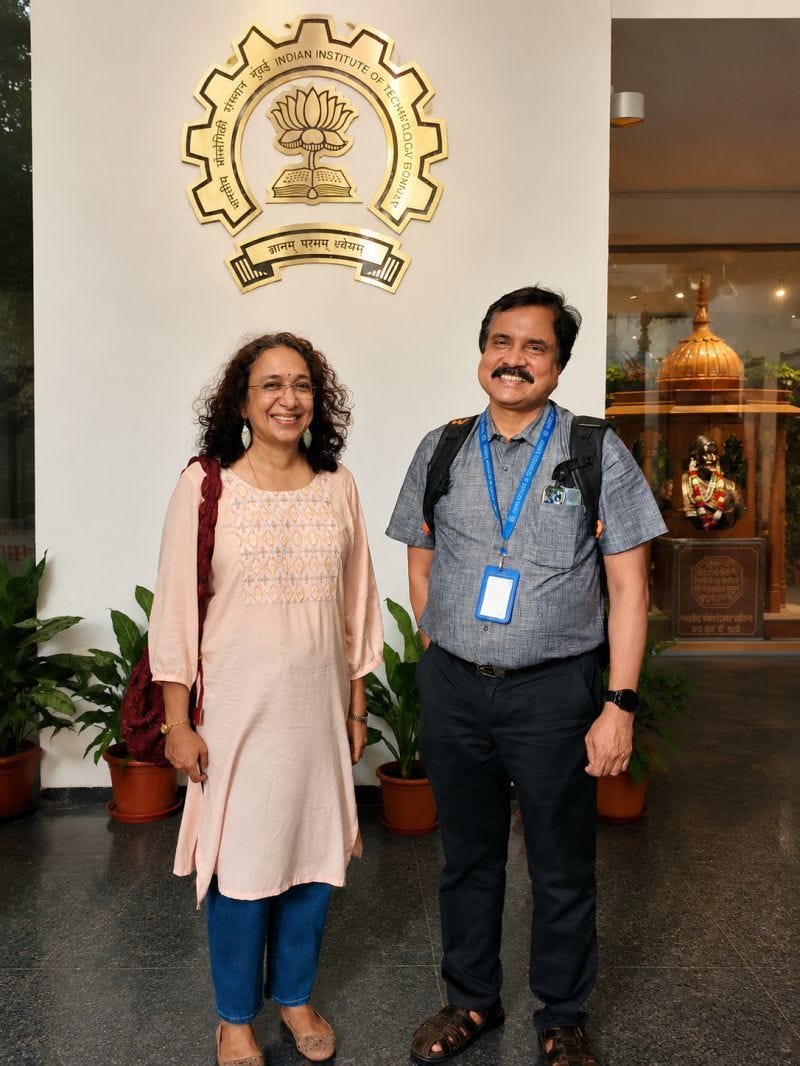
This piece did not start as an interview. It started as a conversation between two very different vantage points — one of us has spent over three decades in rice paddies, observing lichen colonies and sacred groves; the other has spent the last nearly three decades inside the IT industry and now IIT Madras COIN, mapping how AI strategy and human institutions might learn to think together. We began this conversation expecting to write a profile. We left having found that we were already speaking the same language, just in different dialects.
Long before “co-intelligence” entered the vocabulary of AI strategy, Hariharan was already practising a version of it — just without the algorithms.
Now, as Professor of Practice at IIT Bombay’s Centre for Technology Alternatives for Rural Areas (C-TARA) and for over three decades at the M.S. Swaminathan Research Foundation (MSSRF), Hariharan has worked at the exact point where ecology, livelihood, nutrition, and technology meet. Lichens that feed rural incomes. Rice that survives the sea. Sacred groves that double as living laboratories. Farm tools designed for the hands that actually hold them.
Partway through our conversation, we realised that this body of work mapped with onto a framework the IIT Madras COIN Network has been building for its own purposes: the Future of Planet, one of the Five Futures of Co-Intelligence recently outlined by Venkat Ramaswamy and Krishnan Narayanan. That framework calls for NEST harmonization — aligning Nature, Society, Economy, and Technology — so that AI and human systems together heal and regenerate the planet rather than overextract from it.
See:

Hariharan has been doing exactly this for forty years. He just calls it as Understanding the Grand Five elements or the Pancha Bootha.
The Five Elements as a Diagnostic Lens
Pancha Bootha — Earth, Water, Fire, Air, and Space — is one of the oldest organising frameworks in Indian thought. In Hariharan’s hands, it becomes less philosophy and more a working diagnostic through a scientific approach: when an ecosystem or a community system is failing, look at which element has been starved of attention.
A pattern recurred through his fieldwork, and through our conversation about it: ecological systems decline not because of one dramatic failure, but because of overextraction or overdose (pollution) due to human action impacting the basic function. Once that purturbance is identified and restored, the ecosystem doesn’t just recover; it reorganises itself toward what he calls — ‘the beauty of resilience’ that helps it in to a regenerative state rather than remaining a depleting one. Human action must facilitate this regeneration with the advancements in AI, Planetary and ecological studies. Our understanding on the underlying causes are crucial at this juncture to correct the exceeding factors back within the safe operating space indicated in the Planetary boundaries framework that defines the safe operating space for humanity based on nine critical Earth system processes. Proposed by the Stockholm Resilience Centre, crossing these scientifically established limits risks triggering irreversible environmental tipping points and destabilizing the conditions that support human civilization.
That is, almost word for word, what NEST harmonization is reaching for. Together, we mapped the two frameworks onto each other, element by element, using examples drawn directly from Hariharan’s own work.
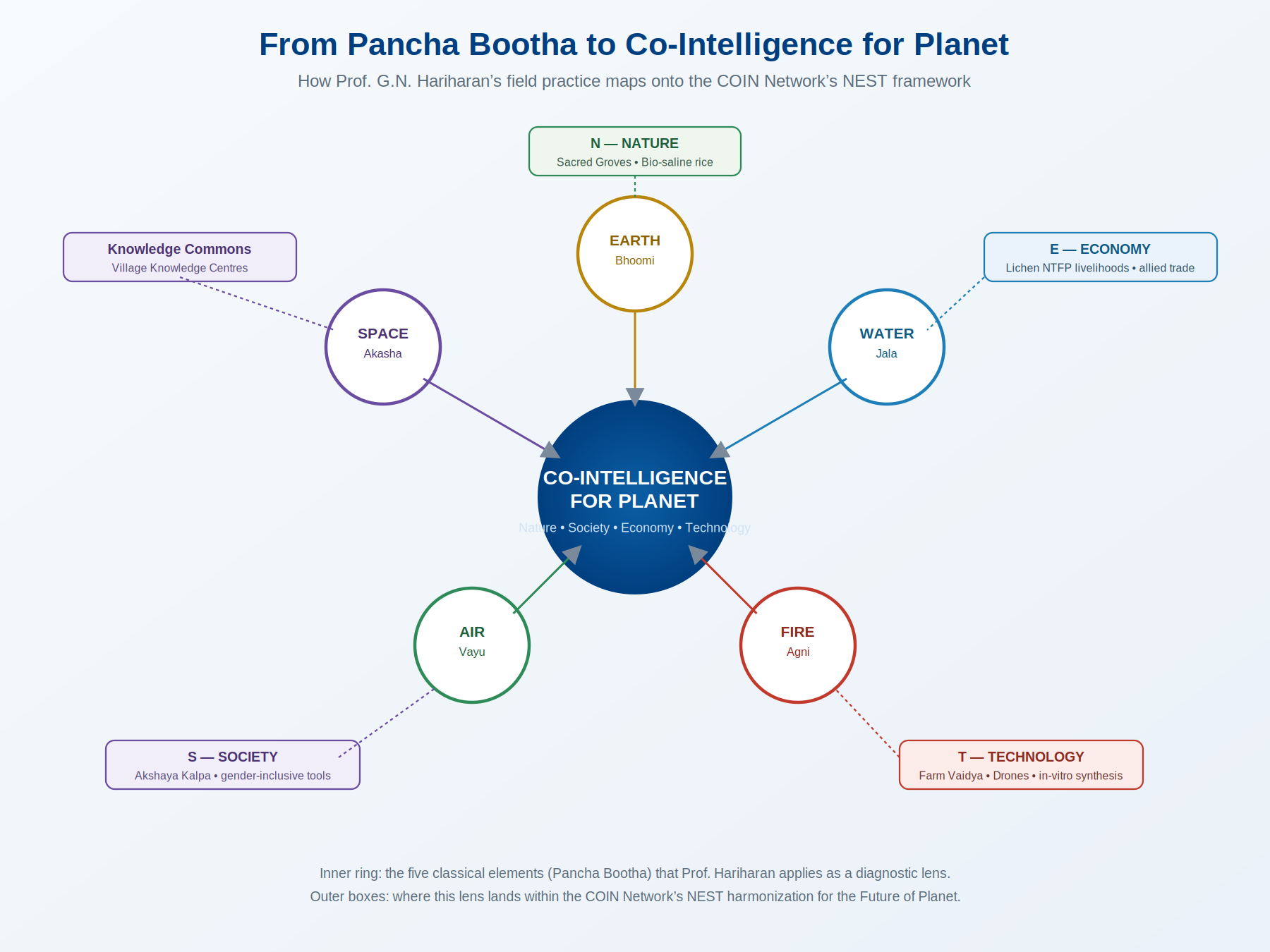
Figure: Pancha Bootha mapped to NEST harmonization for Co-Intelligence for Planet — co-developed by the authors
It is a small but telling thing: a framework rooted in classical Indian cosmology and a framework built for the AI era arrive at the same place — because both are, at root, trying to solve the same problem. Narrow, extractive optimization breaks systems. Relational, whole-systems thinking heals them.
Four Stories from the Field
The stories below are Hariharan’s — four decades of fieldwork condensed into four moments. We have organised them here against the NEST lens, but the work itself long predates the framework.
A Nature based Solution (Nbs) to heal Earth: A Forest Inside a Tech Campus
One of the more unusual initiatives Hariharan described is already growing on the IIT Bombay campus: one acre of land being used to regenerate a fragment of Western Ghats forest — a living sacred grove, in effect, inside one of India’s premier technology institutions.
Sacred groves are India’s oldest model of in-situ biodiversity conservation, traditionally protected by communities rather than by law. Bringing that model onto a campus built for AI, data science, and engineering is itself a quiet statement: regeneration and innovation don’t have to live in separate buildings.
This sits alongside his long-running work on bio-saline agriculture — breeding and field-testing traditional salt-tolerant rice varieties as a direct defence against sea-level rise and soil salinisation, a problem that will only intensify for coastal India under climate change.
Water and clean Air responsive Lichens → NTFP Economy: as Livelihood
Hariharan’s scientific origin story is, fittingly, about an overlooked yet a key symbiotic fungi, naturally ‘the inventer of Agriculture’ cultivating photosynthetic algae within them and feed the wild microbial fauna. His group’s research on lichens — long dismissed as botanical curiosities — opened a new economic pathway: linking the ecological protection of lichen-rich habitats to the livelihoods of the rural communities who collect them as Non-Timber Forest Produce. His team even developed in-vitro synthesis protocols so that lichen compounds could be produced without depleting the wild populations communities depend on.
It’s a clean example of NEST’s “Economy” pillar done right: value creation that strengthens, rather than strips, the ecological base it depends on.
Societal Needs: Designing the appropriate technologies for Who Actually Farms
A pointed observation from our conversation: most farm machinery is still designed for male bodies and male labour patterns — even though women carry a disproportionate share of agricultural work in India. Hariharan’s position is unambiguous: Farm implements should be designed for women farmers as a starting principle, not retrofitted afterward.
This connects to a student-led nutrition mission Hariharan has been mentoring, now seeking to expand. Its founding insight — that stress that a healthy body hosts a healthy mind and hence even take academic and life pressure. This can be meaningfully addressed through evidence-based nutrition interventions for improving cognitive abilities and treats food and nutrition not as a side issue to mental health, but as one of its instruments.
Space and other galloping Technologies: Small Tools, Big Reach
The technology layer in Hariharan’s world is deliberately unglamorous: RS and GIS and drones and other important technologies to reduce the physical drudgery of farm labour, and Farm Vaidya, a digital advisory tool connecting agricultural and nutritional guidance directly to farming communities. Neither is framed as a moonshot. Both are framed as infrastructure — quiet, scalable, and built around the people who will actually use them.
This is precisely the texture of technology that NEST harmonization calls for: AI and digital tools in service of regeneration and dignity, not optimisation for its own sake.
Why This Matters for the COIN Network
The COIN Network’s Five Futures frame development not as GDP growth or infrastructure rollout, but as the co-creation of ecosystems that amplify human potential and dignity — citing examples like MahaVISTAAR, where federated, open networks let communities shape their own development pathways.
We came to see Hariharan’s body of work as a forty-year-deep case study in exactly that idea, built before the framework had a name. On-Farm trials, participatory rice trials with state agricultural universities, mangrove restoration designed around fisher livelihoods, sacred groves as conservation infrastructure — these are all instances of communities and ecological systems being treated as co-creators, not as targets of intervention.
If the Future of Planet asks what it looks like when AI and human systems together heal rather than extract, we believe Hariharan’s career is one of the clearest existing answers — built in rice paddies and lichen colonies decades before the term “co-intelligence” existed.
An Invitation, From Both of Us
The COIN Network exists to bring exactly these kinds of practitioners — technologists, ecologists, policymakers, and community workers — into the same room. Writing this together taught us something neither of us fully expected going in: some of the most rigorous co-intelligence thinking in India didn’t start in an AI lab. It started in a paddy field, a lichen colony, and a sacred grove.
As COIN continues building toward its Future of Planet agenda, we hope this piece stands as one small proof of the method itself — a technologist and a field scientist, writing as equals, arriving together at an idea neither of us would have reached alone.
About the Authors
Srividhya VS is a Strategy Lead - Future of Work, working across the Co-Intelligence Network (COIN), the Wadhwani School of Data Science & AI, and CeRAI. Her work focuses on AI strategy, ecosystem partnerships, and translating institutional research into public-facing narratives. She has 28+ years of experience in the global IT services industry, held senior leadership roles at Infosys, and is currently active across advisory, research, and academic capacities.
https://www.linkedin.com/in/srividhyavs/
Prof. G.N. Hariharan
Prof. G.N. Hariharan is Professor of Practice at C-TARA, IIT Bombay, and was formerly Director of Biotechnology at the M.S. Swaminathan Research Foundation (MSSRF) for over 29 years. His research spans bio-saline agriculture, lichen bioresources, nutrition security, and grassroots ecological restoration. He has authored over 40 peer-reviewed papers and guided ten doctoral students. Link to his profile - https://www.ctara.iitb.ac.in/node/212
This piece was co-written by Srividhya VS and Prof. G.N. Hariharan as part of the IIT Madras COIN Network’s ongoing exploration of co-intelligence in practice. For more on the Five Futures framework referenced here, see COIN #37: The Five Futures of Co-Intelligence: